Eliminating foot odour: the power of Astringent Gel
21/09/2023
Plantar dyshidrosis: treatment according to DermaClub
21/09/2023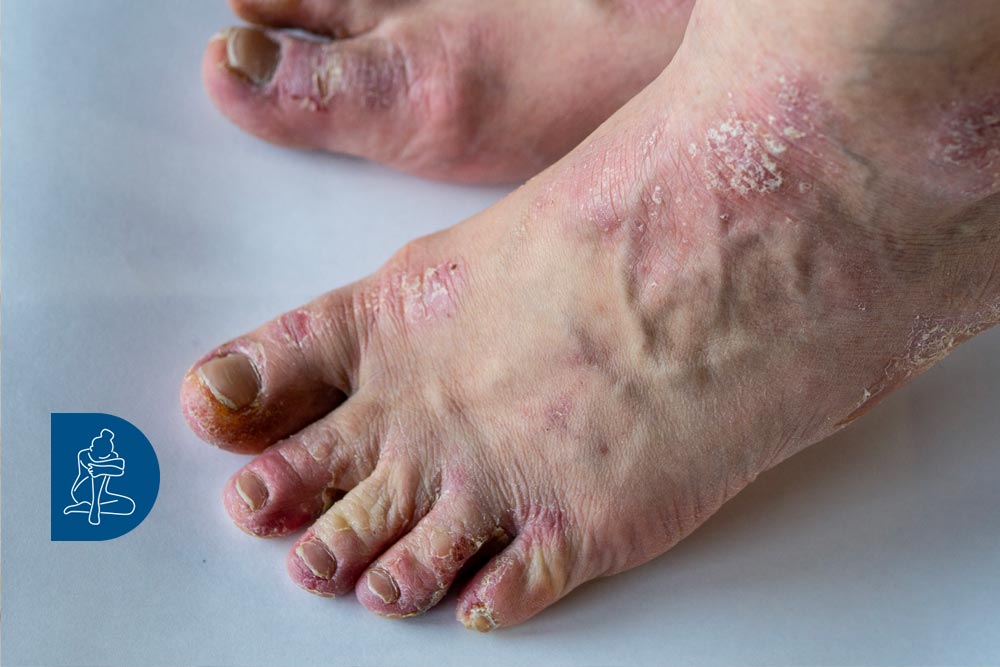
Psoriasis is a growth disorder of the keratinocytes, which are the cells that make up the epidermis. The haphazard growth of the cells results in the formation of reddened and flaky skin in some areas.
Indice
Clinical overview
There are three characteristics of psoriasis
- erythema
- overgrowth (plaques)
- desquamation

Psoriasis on the feet
Psoriasis on the feet does not usually cause plaques to form as in the rest of the body. This is because the skin is constricted within shoes which makes the skin more moist and makes any scaling that does happen less obvious.
Psoriasis on the foot manifests itself in a polymorphous manner and looks quite different from the rest of the body, which can make it more difficult to diagnose. Despite all this, the usual psoriasis symptoms of erythema, plaque and scaling are still present.
There are five categories of foot psoriasis:
- Plantar psoriasis
- Pompholyx (dyshidrotic eczema)
- Nail psoriasis (psoriatic onychopathy)
- Dorsal psoriasis of the foot
- Psoriatic arthritis of the foot
Plantar psoriasis
Plantar psoriasis is very common and, in cases of palmoplantar psoriasis, will be combined with the palmar form of the condition.
The appearance of plantar psoriasis varies considerably depending on whether it is inflammatory, hyperkeratotic or desquamated.
Its appearance can also vary due to factors such as the person being overweight, the type of footwear used and past psoriasis treatment, particularly that of cortisone. However, in most cases, plantar psoriasis is well demarcated, erythematous and causes scaly patches to form.
The photo shows a predominantly erythematous form of plantar psoriasis. Hyperkeratosis is present only at the heel and is caused by pressure or friction against the skin. While desquamation is minimal due to the particularly moist condition of the plantar skin, there is clear demarcation between the plantar area with psoriasis and the healthy dorsal skin.

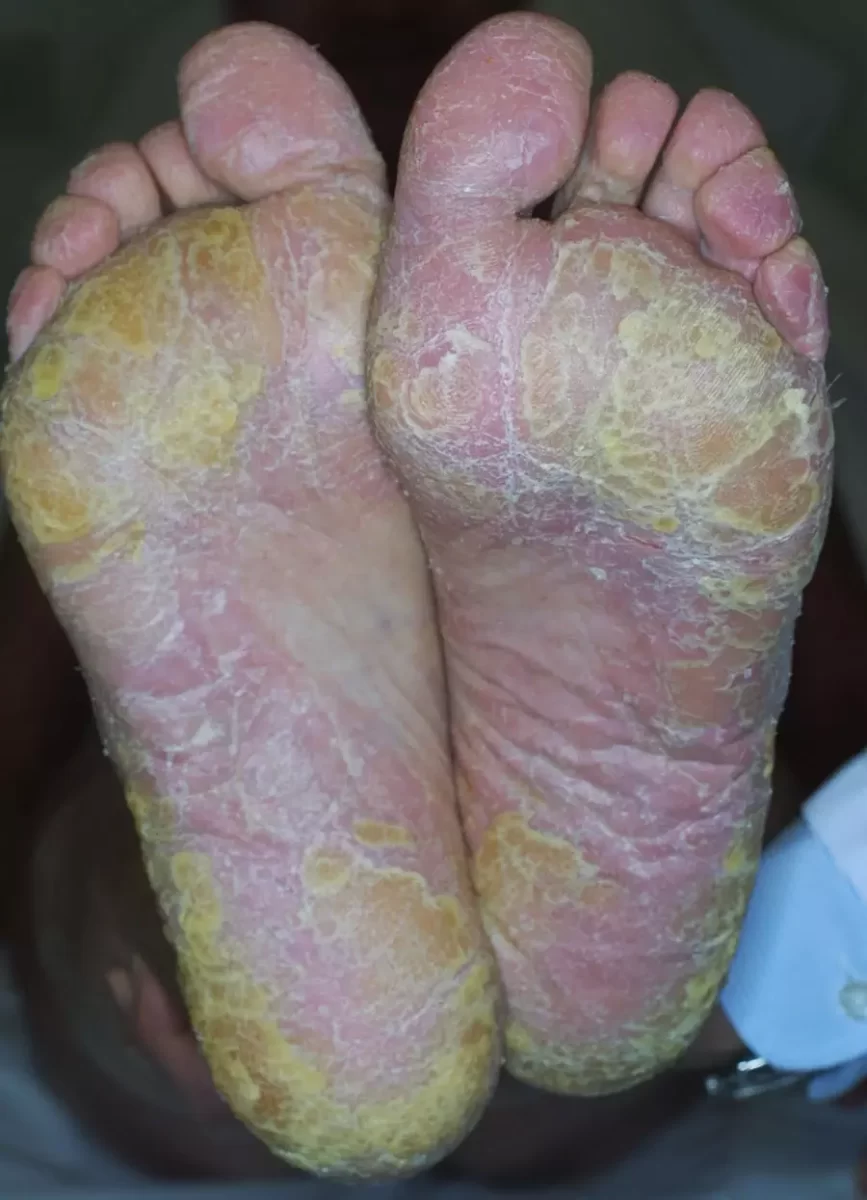
Hyperkeratotic psoriasis
Hyperkeratotic plantar psoriasis causes the formation of hyperkeratosis plaques on the sole. In areas where particular pressure is applied such as on the heel, this form of psoriasis can also cause fissuring and desquamation, but will appear more mildly in non-weight bearing points.

Plaque psoriasis
Plaque psoriasis is less common. It can be recognised by patchy plaques on the skin which are caused by the uneven scaling of the stratum corneum due to abnormal keratinocyte growth underneath this layer of skin.
In some cases, and in the photo below, all three clinical indicators (erythema, hyperkeratosis, and scaling) are equally present on the same foot. As the photo below shows, hyperkeratosis doesn’t necessarily affect the whole sole of the foot.
In this case, it spares the arch but diffuses across the rest of the plantar area.
In other cases, the opposite occurs. As the photo below shows, psoriasis affects only the arch of the foot, leaving the rest relatively untouched.
Localized, clearly-defined hyperkeratosis that has not been caused by friction or pressure should also be diagnosed and treated as a case of psoriasis.


Palmar plantar pustulosis (PPP)
Palmar plantar pustulosis (PPP) is one of the most common presenting forms of plantar psoriasis and often causes small vesicles to form below the stratum corneum.
The vesicles are collections of serum and mainly neutrophilic leukocyte cells within the epidermis.
Over time, the vesicles surface and open onto the stratum corneum, causing redness scaling and a small, crater-like indentation to form where the vesicle has opened.
PPP often causes severe itching and burning, at least until the vesicles open.
In some cases and in the photos below, PPP can appear with large bullous lesions, caused by the confluence of multiple vesicles.
PPP may also cause cloudy, creamy pustules with pus-like contents. These pustules are sterile and should not be confused for other plantar inflections, such as abscesses.


Dorsal psoriasis
Psoriasis may exclusively affect the dorsal region of the foot. Instead of hyperkeratosis and desquamation, the most obvious sign of psoriasis on the dorsal is that of erythema which is in part due to the role footwear plays.
The fact that psoriasis can affect either the dorsal or plantar portion of the foot demonstrates the fact that the foot is composed of two very distinct regions.
While skin of the feet may appear to be the same, in the face of the same pathological conditions, the two regions have very different, independent reactions from the other.

Nail psoriasis (psoriatic onychopathy)
One of the most common forms of psoriasis in the feet is that which affects the nails. Also known as psoriatic onychopathy, nail psoriasis causes the laminae, often of the first toe, to change color and shape. The nails may become opaque, yellowish or light brown, while the lamina may detach from the nail bed. In addition, scales that are particularly difficult to remove may form in between the detached lamina and the nailbed. In acute forms of nail psoriasis, the nail completely detaches and falls off. For reasons that remain unclear, many people with nail psoriasis receive a misdiagnosis of nail mycosis. This means that they receive treatments for mycosis which include lacquers, antifungal creams and sometimes oral medication which, of course, do not lead to any improvement in cases of nail psoriasis and can actually worsen the condition.


Treatment
As with other forms of Psoriasis, plantar psoriasis should not be treated with cortisone. There is an apparent initial improvement, followed by a worsening of symptoms once treatment is stopped or even whilst treatment is still ongoing. Furthermore, the skin on the feet is severely damaged by the use of cortisone.
DermaClub recommends using natural treatments such as sulphur, salicylic acid, sulphonated ichthyol or coal tar.
The recommended treatment for plantar psoriasis is to apply 2S Cream in the evening and PEG Ointment in the morning, using a small amount of product and massaging it in thoroughly.
To achieve the best results, you should also stop washing or getting your feet wet, as every wash can irritate psoriasis. To keep your feet clean without washing them, you can use what is known as ‘dry washing’ with a Potassium permanganate solution, as explained in the relevant article.
In the dyshidrotic form, you can replace 2S Cream with Dermictiol cream in the evening and PEG Ointment in the morning, whilst always limiting or, better still, avoiding washing or wetting your feet.
For nail psoriasis, apply Onicosana in the evening both around the edge of the nail and between the nail and the nail bed on the free edge of the nail. As in most cases of psoriasis, areas of the feet and nails affected with the condition will benefit from responsible sun exposure.